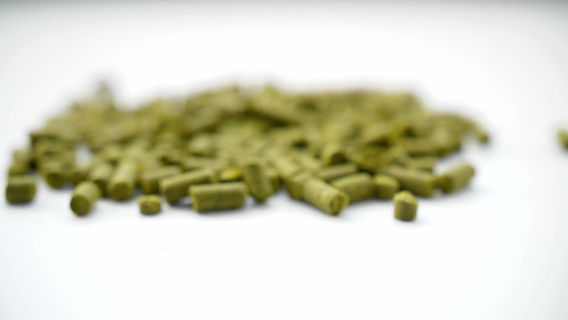
Herbs, plants & stalk goods
Plant and herb residues and stalk goods can be converted into animal feed, bedding or energy pellets.
The production of herbs often results in large amounts of residual materials, e.g. stalks, flowers, etc. These can be formed into excellent feed pellets. These treats are not only a treat for every animal, but also 100% natural, without additives and also very healthy.
Many horses have an allergic reaction to hay feeding with coughing, breathing difficulties, asthma and headshaking. So far, watering the hay, switching to haylage or dry grass were the only ways to provide affected horses with forage.
By pelleting the hay and adding tasty herbs and plants, the animals can eat the feed without the hay dust developing!
Further advantage: By pelleting, the hay-herb feed mixture can be stored for a long time and the required storage space can be reduced many times over!
Alfalfa to animal feed pellets
Lucerne is a two- to three-year-old, blue-flowering plant that belongs to the legume family and is a natural supplier of essential amino acids and minerals. Not only does it offer a valuable source of nectar for bees and bumblebees in summer, it is also ideal animal feed. In ancient times it was used in Persia as a basis for the fodder of horses. In fact, it is the oldest cultivated crop used in agriculture exclusively for fodder. Lucerne is also called the "queen of the forage plants" because of its valuable feed properties, such as high-quality protein, ß-carotene, many vitamins and minerals. Alfalfa is an ideal concentrated feed, especially for breeding, sport and young horses, because it provides 50% more digestible energy than hay.
Alfalfa pellets can be fed not only to horses but also to calves, goats, sheep and rodents. Alfalfa can also be converted into premium organic feed pellets for better sales and easier dosing. Another advantage of converting to pellets is the saving of storage space due to the extreme reduction in volume.
Miscanthus to energy pellets
Miscanthus, also called elephant grass, Chinese reed, Chinese grass or bamboo reed, is the ideal energy grass, because 1 hectare replaces around 3,000 - 7,000 liters of heating oil! These are very fast-growing, hardy, deciduous and clump-forming grasses. Miscanthus is a perennial reed plant that reaches heights of growth of up to 4m after the third year and can be grown on any soil suitable for corn. The useful life of Miscanthus is over 20 years. In Germany, miscanthus is cultivated on approx. 4,500 hectares for various material and energetic purposes.
Since miscanthus is a rapidly renewable raw material, it is used for ecological biomass production. If miscanthus is converted into high-quality pellets, this naturally biogenic raw material can be used for heating, as animal bedding or even as garden mulch in horticulture. It is also an environmentally friendly alternative to plastic products in the automotive and construction industries.
Benefits of converting miscanthus into energy pellets:
Valuable, energy-rich, natural raw material can be used for mechanical firing
Easy resale in small and large units
Saving storage space through extreme volume reduction
Saving of transport and disposal costs
Saving heating costs through self-sufficiency
Additional income opportunity by selling the pellets
Increasing independence, the production and supply of fuel can be done on site
Protection from bugs
Protection against mold formation
Easy dosing
Lime Mint to Tea Pellets
Lime mint belongs to the spice mint family similar to orange mint and has a slight lime/lemon scent. Round-leaved lime mint has many beneficial properties as a medicinal plant. In the form of tea, it is effective against nausea, loss of appetite and stomach upset. Due to its sweet aroma, lime mint is also ideal for sweet dishes, desserts and fruity shakes, but also for refreshing drinks and tea.
The ideal time to harvest the mint leaves to get a particularly intense taste is early summer when the weather is warm and sunny, as the mint then produces a particularly large number of essential oils. Drying has proven to be the best method for subsequently preserving and preserving the refreshing aromas.
After drying, the leaves are crushed, leaving very fine residual material, which is unsuitable for filling, for example in tea bags, due to its consistency and volume.
By pelleting this lime mint material into tea pellets and then crushing it in a pellet crushing machine, all of the excess residual lime mint material can be reused.
Key benefits for converting to tea pellets:
Increase in sustainability by using all leftover material and avoiding waste
Saving of storage space and transport costs through extreme volume reduction of approx. 9:1
Weight optimization for filling in tea bags
Coffee husk residues into energy pellets
Brazil is the world's largest coffee producer and coffee exporter, with around 300,000 coffee farms. Coffee does not grow everywhere as these little plants are very demanding.
A balanced climate with low temperature fluctuations, a lot of precipitation and a nutrient-rich soil, as well as a lot of protection from the sun are necessary to even be considered as a location for a coffee plantation. It also requires a lot of care and attention so that top varieties can be grown.
When harvesting and manufacturing the valuable beans, a lot of pods, stalks and leaves are produced. Most of the material is simply disposed of unused by the coffee farmers. There is still a lot of energy in the biogenic residues.
The calorific value of the coffee peel residues reached approx. 4.5 kW/kg in test pelleting, which is only approx. 10% less energy than premium DIN pellets made from 100% spruce.
The coffee shell pellets could be used as fuel for heating or for the daily hot meal, and that is 100% CO2-neutral and available in gigantic quantities.
Key advantages for converting to energy pellets:
Saving of storage space through extreme volume reduction of approx. 15:1
Saving of transport and disposal costs for disposal by third parties
Saving heating costs, through self-sufficiency
Additional income opportunity by selling the pellets
Increase of independence, the production and supply of fuel can be done on site
Increase in sustainability by using operational resources and avoiding waste (waste material becomes valuable material again)
Animal feed made from leftover spices, a dream of a wonderful aroma of parsley and chives. The residues from the production of spices are converted into high-quality animal feed pellets. Incredibly popular with rabbits and guinea pigs.
The more unusual the ideas, the more surprising the results.
Stalks of savory and marjoram, for example, can be excellently pelletized and used as high-quality fuel and thus for energy production.
One kg of the conventional "waste product" contains about 5 kw of energy, which corresponds to half a liter of heating oil!
Areas of application for the pellets:
Fuel
Energy production
During the pelleting by our Ecokraft pelleting machine model series, almost 100 degrees Celsius arise during processing, which brings the biomass into the desired shape and makes it durable for a long time.
All pelleting machine models are characterized by their excellent workmanship and the permanent high-performance output. In addition, we completely dispense with binding agents in the production of pellets and are thus clearly distinguishable from the market!
Sunflower shells for heating pellets
According to proplanta, after rapeseed (6.5 million tons), sunflower cultivation with approx. 4.2 million hectares is the second most important oil crop in Europe. Sunflower oil is particularly popular in Germany because it is rich in vitamin E and unsaturated fatty acids.
After pressing, the oil cakes are usually processed into high-quality animal feed, but the sunflower shells are often disposed of unused in gigantic quantities.
This biogenic residual product still offers so much potential. With a residual moisture content of between 10 and 15%, the shells can be pelleted immediately and without being crushed. The extremely stable pellets are ideal for combustion, as the calorific value is an incredible 5.15 kW/kg, which is 5% more heat output than premium wood pellets (4.9 kW/kg). This material is really too good to be disposed of.
Key benefits for converting to energy pellets
- Saving of storage space through good volume reduction of approx. 4 : 1
- Saving of collection and disposal costs, since fewer trucks collect the material and bring it to landfill/incineration
- Saving heating costs through self-sufficiency
- Additional income opportunity by selling the pellets
- Increase of independence, the production and supply of fuel can be done on site
- Increase in sustainability by using operational resources and avoiding waste (waste shells become valuable materials again)
Plant residues for fertilizer pellets
In Germany alone, it is estimated that there are around 1,200 hectares of greenhouse cultivation area for vegetables, fruit and flowers under glass or plastic covers. In many cases, large amounts of biogenic plant residues remain after harvesting. These take up an enormous area and are usually disposed of in biogas plants for a fee.
In a pilot experiment, leftover tomato plants have now been dried and pelleted into fertilizer pellets. The volume was reduced by an incredible 18:1. The dried plant residue pellets can be transported and dosed wonderfully and can be stored in a space-saving manner until they are used as fertilizer. This means that greenhouse operators can produce their own fertiliser, use it themselves or even sell it. A project for sustainability and with high future potential.
Key benefits for converting to fertilizer pellets
- Saving of storage space through extreme volume reduction of approx. 18 : 1
- Saving of collection and disposal costs, since fewer trucks collect the material and bring it to disposal
- Saving costs for fertilizer through self-sufficiency
- Additional income opportunity through the sale of fertilizer pellets
- Increase of independence, the production and supply of fertilizer pellets can be done on site
- Increase in sustainability by using operational resources and avoiding waste (green waste becomes valuable material again)
Hemp is one of the oldest crops in the world. Mainly because all parts of the plant can be usefully processed in a variety of ways. For example, since early history and antiquity, ropes and cloths have been made from the fibers of the stems, edible oils from the seeds and essential oils from the distilled leaves and flowers.
The mostly annual plant can reach a height of up to 5 meters and grows dense and upright. In the middle of the 20th century, the plant was replaced by plastics. Hemp has only regained popularity in agricultural cultivation since the 1990s.
Hemp seeds are high in protein, carbohydrates, fats, and high in fiber and various vitamins and minerals. Hemp nuts and hemp oil contain more than 90% polyunsaturated fatty acids, such as omega 3 fatty acids.
Thanks to its unbeatable, biological properties, many hemp products have found their way back onto the market. Currently 52 hemp varieties are allowed to be cultivated in the EU.
Hemp has many incredible benefits:- Extremely resistant- Does not mold, even when damp or wet- Can be recycled multiple times
Hemp pellets are therefore ideal as bedding (does not mold) and as an energy source.
1kg of hemp pellets has a calorific value of approx. 4.5 kWh. This means that 2 kg of hemp pellets could replace almost one liter of heating oil, and it would be clean, sustainable and climate-neutral.
Hops and malt God preserve...
True to the motto, more and more raw hops (without stalks) are pressed in pellet form, while the alpha acid content remains constant and the shelf life is significantly increased. In addition, the raw hops are protected from vermin, dirt and dust, and transport, storage and, above all, dosing are usually much easier.Due to the increasing number of hobby and micro breweries, a kilogram of hop pellets is currently being traded for around 40 euros.
Area of application for the pellets:
Resource
Hops cones are an extremely sensitive raw material and it is therefore very important not to heat the raw material to over 60 degrees Celsius.
The LP22 pelleting system optionally controls the pressing chamber with a temperature sensor, so it is not possible to exceed 60 degrees Celsius, since the LP22 stops production immediately so that no ingredients and flavors are lost.
Without the addition of binding agents, this creates an excellent natural product for the production of beer.
Almost seven million tons of peanut shells are produced every year in global peanut processing. Peanut shells have many positive properties and, as a renewable raw material, can replace environmentally harmful styrofoam and can be used as fertilizer, as a fire starter or for generating electricity.
In a development project in Senegal, German engineers built a biomass power plant using mainly peanut shells as a renewable energy source and which now provides electricity for the 1200 inhabitants of a village. Work is already underway in many other places to use such peanut shells as energetic biomass.
Since the 1970s, researchers have been working on making hydrogen the energy carrier of the future and obtaining it from naturally renewable raw materials such as peanut shells. The prospects are promising.
A project for sustainability and with high future potential.*
In a pilot test, peanut shells have now been crushed and converted into energy pellets. The dried energy pellets can be easily transported, dosed and stored in a space-saving manner until they are used. Another big advantage is that they are a natural, resource-saving and cost-effective alternative to oil and gas.
*Source: https://www.erdnuesse.de/knowing-values/detail/wusstest-du-dass-erednuss shells-zu-many-various-products-further-processed/
As a rule, the fermenter contents (slurry, solid manure and energy crops such as corn, grain, grass silage or agricultural by-products and biowaste) found in the production of biogas in biogas plants are referred to as fermentation substrates after fermentation. This residual biomass material is ideal as a fertilizer because almost all of the trace elements contained, almost all of the nitrogen, phosphorus and, depending on the process, all of the sulfur remain in the fermentation substrate. Due to the fermentation, the fertilizer is far less chemically aggressive towards the plants than the raw liquid manure. In addition, the availability of nitrogen for the plants is more optimal and the smell is far less intense. The fermentation residue accounts for approx. 50% of the initial mass used.
Because the fermentation substrate, like normal liquid manure, must not be spread on agricultural land in the winter months, biogas plant operators must have a large storage capacity. This required storage area could be drastically reduced by pelleting. In addition, the resulting fermentation substrates can be optimally transported and dosed for application. The nutrients and minerals in the fertilizer are slowly released back to the agricultural land through the compacted pellets. In some cases, the fermentation substrate is also incinerated to further reduce the quantity or to generate energy.
Areas of application for the pellets:
Fertiliser
Energy generation
During the pelleting by our Ecokraft pelleting machine model series, almost 80 degrees Celsius arise during processing, which brings the biomass into the desired shape and makes it durable for a long time.
All pelleting machine models are characterized by their excellent workmanship and the permanent high-performance output. In addition, we completely dispense with binding agents in the manufacture of pellets and are thus clearly distinguishable from the market!
Stinging nettle (powder) to tea pellets
The stinging nettle, a real nutrient bomb and bacteria brake. The stinging nettle genus includes around 45 different species and is used in a variety of ways around the world. It is a very useful plant and is therefore often used in the kitchen, naturopathy and in the garden. As nettle manure, it can even replace artificial fertilizers and pesticides. The stinging nettle is also ideal as a food - not only because of its abundance of vital substances, but also because of its excellent taste.
The stinging nettle contains more vitamin C than citrus fruits and is also rich in minerals such as iron, potassium, magnesium and phytochemicals such as flavonoids. It is therefore also known as a medicinal plant for a variety of uses.
These include, for example:
Prevention of urinary tract and prostate diseases
Improvement of the defenses
Detoxifying & Purifying
Digestive
Anti-inflammatory
Diuretic
Antispasmodic
Stimulates blood circulation
Pain Relief
Due to the many positive properties, nettle is also a very popular infusion drink and is therefore often drunk as nettle tea. Nettle tea has a draining effect because the flavonoids have a slightly diuretic effect. This helps against urinary tract infections and can stop a developing bladder infection.
To make nettle tea, the young shoots are cut off at the base and the tiny thorns are removed. The leaves are then dried and crushed.
When crushing the dried stinging nettles, very fine, sometimes even pulverized residual material is produced which, due to its consistency and volume, is not suitable as loose material or for filling into tea bags.By pelleting this stinging nettle powder into tea pellets and then crushing it in a pellet crushing machine, all of the excess residual nettle material can be used.
Key benefits for converting to tea pellets:
Increase in sustainability by using all leftover material and avoiding waste
Saving of storage space and transport costs through extreme volume reduction of approx. 6:1
Weight optimization for filling in tea bags
Maize curds into energy and feed pellets
When corn is transported, stored or sifted out, fine broken corn and dust accumulate as residual material. However, this natural material should not simply be disposed of (with costs), because it can still be used in many different ways. If you pellet the corn curd and convert it into feed pellets, you have an excellent feed for poultry, pigeons, rabbits, horses or fish. In addition, the remaining material can also be used to produce ideal energy pellets, which can be used for heating or for sale. Corn pellets are a sustainable, regionally available and inexpensive source of feed and energy that is good for the climate and makes us all a little more independent.
Other advantages of converting broken corn into feed and energy pellets:
Saving storage space thanks to extreme volume reduction of 3:1
Saving of transport and disposal costs for disposal by third parties
Saving costs for feed - Saving heating costs, through self-sufficiency
Additional income opportunity by selling the pellets
Increasing independence, you can produce and use your own energy and feed pellets
Increase in sustainability through resource-saving reuse and avoidance of waste
The climate in the barn is significantly influenced by the litter. Choosing the right padding and general hygiene is extremely important to ensure that the horses have a comfortable atmosphere in the stable.
Box bedding should be comfortable for the horse, have a high level of absorbency, contain as little mold or toxins as possible and be low in dust.
Especially for horses that are prone to allergies, the right bedding should be carefully selected. The respiratory system of horses is extremely sensitive to dust. In the worst case, there is a risk of chronic respiratory diseases: the horses cough, breathe heavily even at rest and avoid exertion. The symptoms can usually only be alleviated, a cure is not possible. Danger recognized, danger averted! Because sources of dust can be defuse with simple means. Mold from the straw and high levels of dust are often the reasons why horses develop respiratory diseases.
By pelletizing straw into bedding pellets, these are heated to almost 100°C, thus killing mold. In addition, the pellets hardly produce any dust and also contribute to improved hygiene in the barn.
Hay pellets are ideal as animal feed.
Example:
Many horses have an allergic reaction to hay feeding with coughing, breathing difficulties, asthma and headshaking. So far, watering the hay, switching to haylage, haycobs or dry grass were the only ways to provide affected horses with basic feed. By pelleting the hay, the animals can consume the feed without developing hay dust! Another advantage: The hay can be stored for a long time by pelleting and reduces the required storage space many times over!
Hay pellets can be purchased on the open market for around 4 euros/kg. This results in a calculated ton price of 4,000 euros! Become a producer yourself!
Area of application for the pellets:
Feed
All pelleting machine models are characterized by their excellent workmanship and the permanent high-performance output. In addition, we completely dispense with binding agents in the manufacture of pellets and are thus clearly distinguishable from the market!
Green oats to tea pellets
The green oat belongs to the genus of grasses and is basically unripe harvested oats, which are harvested shortly after flowering, before the starch is stored in the grain.
Green oats are very alkaline and contain numerous effective plant substances such as anti-inflammatory flavonoids, immune-stimulating saponins, as well as numerous minerals and trace elements that stimulate metabolism. These ingredients also promote the elimination of uric acid and other metabolic products.
As green oat tea, it is said to contribute in a natural way to alleviating metabolic diseases such as gout and rheumatism, to help with sleep disorders and exhaustion, to have a purifying and draining effect and to balance the acid-base balance.
For green oat tea, the grasses of the oat plant must be harvested when they are in bloom and then dried and crushed.
When the dried green oats are crushed, very fine residual material is produced which, due to its consistency and volume, is not suitable as loose material or for filling into tea bags.
By pelleting this green oat material into tea pellets and then crushing it in a pellet crusher, all of the excess green oat material can be reused.
Key benefits for converting to tea pellets:
Increase in sustainability by using all leftover material and avoiding waste
Saving of storage space and transport costs through extreme volume reduction of approx. 8:1
Weight optimization for filling in tea bags
Oat bran is a by-product of the production of rolled oats.
In the mills specializing in the production of oat flakes, the oats are mechanically dehusked by peeling.
The dehusked oats are rolled and hydrothermally treated so that at the end of this production process there are oat flakes for human consumption. When the oats are processed, most of the shell parts and bran remain, which can be used as a product, oat bran, as food and feed. Oat bran has a crude fiber content of approx. 25% and approx. 6% crude protein and is mainly used as a dietary component in horse and rabbit feed.
However, there is much more to the oat bran than animal feed and it can also be used for other purposes.
Because if you convert the oat bran into high-quality pellets, you can use them excellently as energy or bedding pellets.
Key benefits for converting to energy and bedding pellets:
• Saving of storage space through extreme volume reduction
• Savings on collection and disposal costs
• Saving on heating material & bedding costs through self-sufficiency
• Additional income by selling the pellets
• Increased independence, since the production and supply of energy or bedding pellets can be done on site
• Increasing sustainability by using operational resources and avoiding waste
Husks are the fine coverings between which the grain kernels grow on the ear. In the case of oats, the husk has to be removed in the course of processing in a hulling mill. Oat hulls are therefore the largest by-product of oat processing.
Every year around 2.5 million tons of oats are harvested and processed worldwide. Of this, 29% – that is approx. 725,000 tons – ends up in the biogenic waste in the form of oat husks.
One way of using this valuable residual material again is to convert it into energy or bedding pellets.
The most important advantages of oat spelled pellets:
- Dust-free, especially important for horses with respiratory diseases
- Excellent heat retention
- Very high suction power
- No mold growth and germ-free
- Free from artificial colors, odors, flavorings and preservatives
- Saving of storage space through extreme volume reduction
- Savings on collection and disposal costs
- Additional income opportunity through sale as energy or bedding pellets
- Increasing sustainability by using operational resources and avoiding waste
Husks are the fine coverings between which the grain kernels grow on the ear. During the harvest and the subsequent husking, the husk (= husk) is detached from the spelled grain and remains as a by-product. This valuable natural material is often wrongly declared as waste and accordingly simply disposed of.
By converting it into pellet form, however, this husk can still be used in a variety of ways. Especially among horse owners, the demand for husk pellets as bedding is increasing enormously, because they have a number of positive properties.
These include:
- Ideal as bedding for laying nests and stables
- Dust-free, especially important for horses with respiratory diseases
- Excellent heat retention
- Very high suction power
- Resource-saving use, since only the dirty area has to be mucked out and not the entire litter has to be replaced, as is the case with straw
- No mold growth and germ-free
- Free from artificial colors, odors, flavorings and preservatives
- Saving of storage space through extreme volume reduction
- Savings on collection and disposal costs
- Additional income opportunity through the sale of litter pellets
- Increasing sustainability by using operational resources and avoiding waste
You can pay up to 400 euros for a ton of organic bedding pellets - so don't throw them away!
MATERIAL TEST
Do you have questions about pelleting or are you unsure which solution suits you?
Call us at +49 9962 86734-0,
email us at: office@ecokraft.com
or fill out our inquiry form.
We are happy to help!