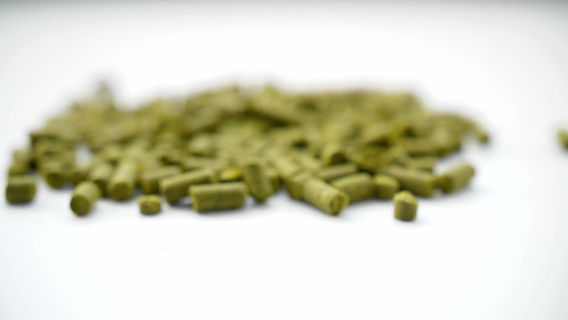
Vegetables & fruits
High-quality animal feed pellets can be made from fruit and vegetable pomace.
Fertilizer pellets made from mushroom compost
When cultivating mushrooms or other mushrooms, a rich residual compost is produced after harvesting, which can be dried and pressed into pellets as a universal fertilizer.
Residual asparagus peel for fertilizer pellets
Asparagus is the favorite vegetable of the Germans and is eagerly awaited in February. The first European asparagus deliveries in February and March usually come from Spain and Greece. Asparagus from German cultivation is then available from April to June. Asparagus is the vegetable with the largest cultivation area of approx. 23,000 hectares in Germany, the per capita consumption is approx. 1.7 kg. According to the Federal Statistical Office, around 130,600 tons of asparagus were harvested in Germany in 2019. During harvesting and processing, however, there are also very large quantities of asparagus leftovers, which have usually only been disposed of up to now.
In a pilot test, leftover asparagus skins have now been dried and pelletized into fertilizer pellets. The volume could be reduced by a factor of 8:1. The dried fertilizer pellets can be transported and dosed wonderfully and can be stored to save space until they are used. This means that asparagus farmers can produce their own fertilizer, use it themselves or even sell it. A project for sustainability and with high future potential.
Significant benefits for converting to fertilizer pellets
- Saving of storage space through extreme volume reduction of approx. 8 : 1
- Savings on collection and disposal costs, since fewer trucks collect the material and bring it to disposal
- Saving costs for fertilizer through self-sufficiency
- Additional income opportunity through the sale of fertilizer pellets
- Increase of independence, the production and supply of fertilizer pellets can be done on site
- Increase in sustainability by using operational resources and avoiding waste (green waste becomes valuable fertilizer again)
Apple pomace
The production of juices or apple products (apple rings) produces very large amounts of apple biomass. By drying them to less than 20% residual moisture and turning them into pellets, these raw materials rich in energy and vitamins can be preserved for years. In pellet form, this high-quality raw material is used as a treat for horses and other small animals. This means that additional income of up to 3 euros per kg can be achieved.
Cherry pits and leftover sea buckthorn into energy pellets
In the production of juices and spirits, large amounts of biogenic residues are generated. These are often given to biogas companies at low cost or disposed of by waste disposal companies for a fee.
In a pilot test, cherry pits and leftover sea buckthorn have now been dried and formed into energy pellets for a spirits manufacturer. The volume was reduced to a third. The dried plant residue pellets can be easily transported, dosed and stored in a space-saving manner until they are used as energy pellets. With a calorific value of approx. 4.6 kW/kg, the biogenic residues can be used very well for energy production.
Key advantages for converting to energy pellets:
Saving of storage space through extreme volume reduction of approx. 3:1
Savings on collection and disposal costs, since fewer trucks collect the material and bring it to disposal
Saving energy costs, through self-sufficiency
Additional income opportunity through the sale of energy pellets
Increase of independence, the production and supply of energy pellets can be done on site
Increase in sustainability by using operational resources and avoiding waste (waste becomes valuable material again)
Info when making spirits
The quality of the fruit essentially determines the quality of the schnapps. Spoiled, overripe, or unripe fruit, berries, or grapes are not suitable for producing quality alcohol. Leaves, stalks, grass and kernels should also not be used for the mash.
Rose hips (powder) into tea pellets
Rose hips have been known for their many beneficial properties for hundreds of years. They are the aggregate nuts of the wild rose and are also known as the "Lemon of the North" because of their very high vitamin C content of over 1,250 milligrams per 100 grams. The rosehip also contains vitamins D, P, K, B1, B2, B3 and provitamin A as well as the important minerals calcium, magnesium, potassium, phosphorus, iron, copper, zinc, sodium, iron, selenium and manganese. This concentrated load of vitamins and minerals makes the rosehip the regional secret weapon among the popular superfoods.
The rose hip is not only a real vitamin bomb, it also has an anti-inflammatory and pain-relieving effect, supports digestion, binds toxins, strengthens the skin and eyesight, protects the blood vessels and can alleviate bladder problems.
When it gets cold, rosehips are also an important food source for native birds.
They are picked from the end of August until well into November, then washed and dried to preserve them for making tea.
When the dried rose hips are crushed, very fine, sometimes even pulverized residual material is produced, which is not suitable for filling into tea bags due to its volume.
By pelleting this rosehip powder into tea pellets and then crushing it in a pelletizing machine, all of the excess residual material from the rosehip can be reused.
Key benefits for converting to tea pellets:
Increase in sustainability by using all leftover material and avoiding waste
Saving of storage space through extreme volume reduction of approx. 5:1
Weight optimization for filling in tea bags
Grape vine leftovers for energy & bedding pellets
In vino veritas - the truth lies in the wine. Wine, whether red or white, has always been the epitome of enjoyment. The grapevine is one of the oldest plants in the world and dates back to 8,000 BC. The first evidence of viticulture can be found in the Middle East. Wine is produced in almost every country, however almost half of the world's wine is produced by just three countries, namely Italy, France and Spain. They are the largest producing countries of wine on the European continent. There are 13 wine-growing regions in Germany today. The vineyards in Germany amount to just over 100,000 hectares. The Rheinhessen and Pfalz regions are among the largest wine-growing regions, each with a cultivation area of over 20,000 hectares.
In the manual harvest, the ripe grapes are cut off by hand. The mechanical harvest is carried out by a harvester that drives over the planted vines. The grapes are harvested by tapping and shaking. The falling grapes are caught by a lamella system. This process also produces residues from the vines, such as branches and leaves, which are usually disposed of at a cost.
However, there is still a great deal of valuable potential in this waste material. If these residues are converted into pellets, they can be used as energy or bedding pellets.
Key benefits for converting to energy and bedding pellets:
Saving storage space through extreme volume reduction
Saving collection and disposal costs
Saving costs for heating material & bedding through self-sufficiency
Additional income opportunity by selling the pellets
Increasing independence, the production and supply of energy or bedding pellets can be done on site
Increasing sustainability by using operational resources and avoiding waste
MATERIAL TEST
Do you have questions about pelleting or are you unsure which solution suits you?
Call us at +49 9962 86734-0,
email us at: office@ecokraft.com
or fill out our inquiry form.
We are happy to help!